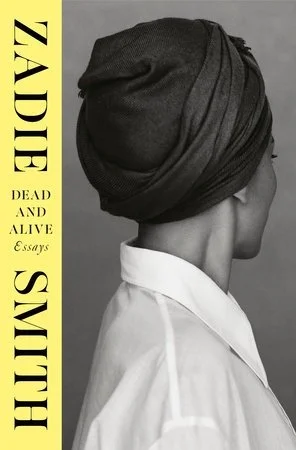
Dead and Alive: Essays - Zadie Smith
It’s been a couple of years since Zadie Smith’s last book, The Fraud (see my review here) but she is back and better than ever in what I feel is her best book so far.
Not everyone can write an essay. I’m decent at it, but I am not Zadie-Smith-level good (and may never be). Because Zadie Smith thinks very deeply about the subjects she writes about. And think she does. In her newest book, readers are treated to a total of 30 essays, divided into five sections: Eyeballing, Considering, Reconsidering, Mourning and Confessing.
Zadie (because she’s my best writer friend in my head) is incredibly observant but also always willing to learn and do research. Like in her essay, “European Family,” her observation skills are off the chart. She basically eviscerates the idea of the “Eurocentric world view” after Zadie visited Miroir du monde, an exhibit that contained about 100 or so objets d’art of Dresden’s Cabinet of Curiosities, or the Kuntskammer. Now, I had never heard of the Kuntskammer in my life and I love art. Zadie talked about what she saw in the exhibit as well as how the pieces were described and positioned throughout. Although the pieces are described as very beautiful, for the most part they were exhibited to uplift the Eurocentric world view as well as exoticize what they are and where they came from. As I read the essay, I couldn’t help but wonder how those pieces were collected, as we know how far-reaching colonization was (and still is in many respects) throughout the world. I especially love this quote from “European Family”:
Looking at them I realized I felt a little sorry for the much vaunted, much dreaded, ‘Eurocentric world view.’ Supposedly all-powerful, and yet so incredibly ignorant! It does not know what it does not know.
The essay that almost broke my brain is the penultimate essay called “Conscience and Consciousness: A Craft Talk for the People and the Person.” I’m not going to lie, I had to read this one twice for two reasons. First, I was tired as hell and wanted to finish the collection before I finally went to sleep. And second, because of said tiredness, I missed the point of the essay entirely. So the next day after a good night’s sleep and a great cup of coffee, I read it again. It is the longest essay in the collection, spanning 20 pages. The essay is supposed to be about the craft of writing, a subject that has been talked about ad nauseum. Zadie starts by saying:
I always find it difficult to come to any general conclusions about the craft of writing.
That’s because there truly is no way that works for every writer. There just isn’t. For example, I am not an “every day” writer, meaning I can’t sit down every single day at the same time to write. I tried it once and I was bored within a week. However, give me a prompt and ten minutes and I become a friggin Pulitzer prize finalist. I write my best work in very short bursts of creativity and I probably won’t ever change. But I know people who can write every day and produce the most beautiful stories. In the essay though, Zadie concentrates more on how much of our consciousness we bring to our writing:
Looking at Picasso’s women or Lynette Yiadom-Boakye’s men, listening to Biggie’s rhythms or Bach’s triads, moving through Fred Moten’s arguments or Shakespeare’s scenes or occupying Octavia Butler’s alternative realities — whenever I am confronted with the art-productions of other people, I am always made acutely aware of one fact: I don’t see that way. Art is one of the ways we reveal the peculiarities of consciousness — for me it’s the clearest way. It’s through other people’s novels, other people’s paintings, or other people’s poems and other people’s music that I am made aware that everybody is not like anyone else, and yet we are all stuck inside these flesh cages, experiencing what we imagine to be a shared reality through a radically singular medium: consciousness.
Zadie Smith is thoughtful in other ways. She provides readers with footnotes and other books she’s read (all of which I added to my incredibly long TBR) throughout the collection, giving us even more insight into her seemingly endless thirst for knowledge. I love footnotes, endnotes, glossaries and maps in books and will read them all. To be honest, I think Zadie could have snuck a few more in there, but I’m greedy.
Dead and Alive: Essays is sitting right next to Jia Tolentino’s essay collection, Trick Mirror on my shelf because both of these books expanded my brain on some level. Both authors write to make their readers think very, very deeply, which can be very intimidating for those who may not feel like they’re intellectual enough. But authors like Zadie Smith don’t ridicule readers who think this way. Instead, she writes her essays so that you want to learn more, to go beyond what you see on the page. And I am thankful for it.
Where to buy: The Lit. Bar Loyalty Bookstores Call & Response Books Reparations Club
Support my book habit: Book Minded Mag's 2026 Wishlist

Zadie Smith, author of Dead and Alive: Essays. Photo courtesy of Ben Bailey-Smith.
For more information about the author, please visit here.